Lighting and Contrast for Low Vision
The best lighting for low vision isn't the brightest bulb. Practical guidance on task lighting, glare control, and contrast for daily life.
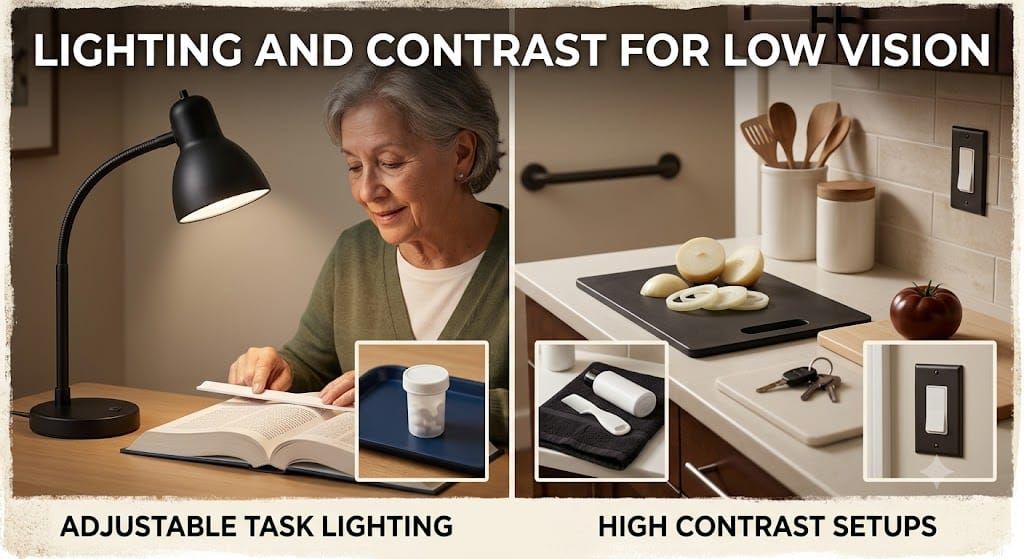
The best lighting for low vision is not necessarily the brightest bulb.
An effective setup is matched to the activity, adjustable, protected from glare, and tested by the person who will use it. Contrast can be equally important because it helps define edges, separate objects from their backgrounds, and make everyday items easier to locate.
Small environmental changes can improve reading, cooking, personal care, household organization, and movement through the home.
Why lighting and contrast matter
Low vision can affect visual detail, contrast sensitivity, peripheral awareness, glare tolerance, and the ability to adjust between bright and dark environments.
Lighting and contrast adaptations can help in several ways:
- Better detail: Properly positioned task lighting can make print, controls, and work surfaces easier to see.
- Clearer edges: Strong contrast can make objects and boundaries easier to locate.
- Less glare: Shielding and positioning light can reduce reflections and discomfort.
- Safer movement: Even lighting and visible boundaries may make hallways, stairs, and fixtures easier to identify.
The same setup will not work for everyone. A person’s eye condition, visual field, glare sensitivity, task, and personal comfort all matter.
Start with the task, not the bulb
Before buying a lamp or changing a room, identify the activity that is difficult.
Reading mail, bills, or books
Try an adjustable task lamp positioned over the page without shining into your eyes. A line guide or typoscope may help you follow the text and reduce surrounding visual clutter.
Preparing food
Use direct lighting over the work surface and create contrast between the food and cutting board. A dark board may help with onions, potatoes, or white bread; a light board may help with dark meat, tomatoes, or other darker foods.
Using stairs and hallways
Provide even lighting that reaches the entire walking surface. Reduce abrupt changes between brightly lit and dark areas. Secure, non-slip contrast markings may help identify stair edges when properly installed.
Selecting clothing
Consistent lighting with good color rendering may make similar colors easier to distinguish. Tactile labels or an organized clothing system can provide information that does not depend on color alone.
Finding bathroom fixtures
Bathrooms often contain white fixtures against white walls or floors. Dark towels, a contrasting toilet seat, visible grab bars, and non-slip contrast accents can make boundaries easier to locate.
Use both ambient and task lighting
Most effective spaces use more than one layer of light.
Ambient lighting
Ambient lighting provides general illumination throughout a room. It supports movement and reduces deep shadows or abrupt transitions between spaces.
Overhead lighting alone may not provide enough light for detailed activities. Increasing overhead brightness can also create unnecessary glare.
Task lighting
Task lighting directs light onto a particular activity or work surface, such as:
- A book or document
- A cutting board
- A stove control
- A medication organizer
- A hobby or workbench
- A keyboard
An adjustable task lamp is usually more useful than a fixed lamp because its position can be changed as the task changes.
Position a task lamp carefully
Place the lamp so that light falls on the task without shining directly into your eyes or reflecting from the surface.
Try different:
- Heights
- Angles
- Distances
- Sides of the work area
- Brightness settings
The best placement may depend on your dominant hand, visual field, posture, and glare sensitivity. If your hand or head creates a shadow, move the lamp to the opposite side or change its angle.
A useful lamp should illuminate the task without forcing you to lean, hunch, or hold the material in an uncomfortable position.
Control glare and reflections
Adding more light without controlling glare can make visibility worse.
Shield exposed bulbs
Choose lamps with shades, diffusers, or recessed light sources. Avoid fixtures that leave bright bulb filaments directly visible.
Reduce glossy surfaces
Reflections from polished counters, shiny floors, glass tabletops, glossy paper, and laminated materials can interfere with useful vision.
Matte surfaces are often more comfortable and predictable.
Manage window light
Use adjustable blinds, shades, or curtains to soften direct sunlight. The goal is to control the light—not necessarily darken the entire room.
Check floors and walking surfaces
Highly reflective floors can create glare or make boundaries harder to judge. Avoid loose rugs and unsecured runners. Any mat should be non-slip, securely positioned, and visibly different from the surrounding floor.
Use contrast to make objects easier to find
Contrast enhancement means placing light objects against dark backgrounds—or dark objects against light backgrounds.
The difference between light and dark is usually more important than the specific colors used.
Examples include:
- White pills on a dark tray
- Dark keys on a light countertop
- A dark cup for water or milk
- A light cup for coffee or tea
- Dark plates on light placemats
- Light-colored food on a dark cutting board
- A dark towel beneath white grooming items
- A contrasting cover around a light switch
- Grab bars that contrast with the wall
Do not rely on color alone for medication identification, safety warnings, or other critical information. Combine color with labels, tactile markers, consistent organization, or spoken information.
Room-by-room ideas
Living room and seating areas
- Place an adjustable floor or table lamp near the primary chair.
- Use pillows that contrast with the sofa to define the seating area.
- Choose solid surfaces and fabrics when busy patterns create visual clutter.
- Make light switches easier to locate with contrasting faceplates or borders.
Bedroom
- Provide an easy-to-reach light near the bed.
- Use motion-activated or touch-controlled lighting along the route to the bathroom.
- Keep cords and charging cables away from walking paths.
- Place frequently used objects on a contrasting tray.
- Choose bedding that is visibly different from the bed frame and floor.
Kitchen
- Add task lighting beneath upper cabinets where appropriate.
- Keep both light and dark cutting boards available.
- Use tableware that contrasts with the food and surrounding surface.
- Reduce patterned tablecloths and visual clutter.
- Add raised, high-contrast markers to important appliance settings.
- Keep sharp tools in consistent, designated locations.
Bathroom
- Choose towels and safety rails that contrast with the wall.
- Use a contrasting, non-slip surface where appropriate.
- Place grooming items on a light or dark mat that makes them easier to identify.
- Use bright, even lighting while controlling mirror reflections.
- Keep walking areas clear and dry.
Stairs and hallways
- Provide even lighting at the top, middle, and bottom of stairs.
- Use continuous handrails that contrast with the wall.
- Keep hallways clear of cords, shoes, boxes, and other obstacles.
- Use securely installed, non-slip contrast markings only when they improve visibility without creating a raised edge or trip hazard.
- Avoid lighting arrangements that cast deep shadows across steps.
Choosing lamps and bulbs
There is no universally ideal bulb or color temperature for low vision.
Consider these features:
Adjustable brightness
A dimmable lamp allows you to change the amount of light for different activities and times of day.
Color temperature
Color temperature is measured in kelvins. Warmer light may feel more comfortable to some people, while cooler light may make certain details appear clearer to others.
Test warm, neutral, and cool settings at different brightness levels. Color temperature alone does not determine whether a light will be effective.
Color rendering
The Color Rendering Index, or CRI, describes how naturally colors appear under a light source. Higher color rendering may help when selecting clothing, preparing food, or completing artwork.
Placement, glare control, brightness, and personal preference are usually more important for general visibility.
Adjustable design
Gooseneck and articulated-arm lamps can direct light precisely. The lamp should remain stable after adjustment and should not tip easily.
Electrical safety
Keep cords outside walking paths. Do not use damaged cords, overloaded outlets, or unsafe extension arrangements.
Hardwired fixtures, stair lighting, and bathroom electrical work should meet applicable building and electrical requirements and be completed by a qualified professional when necessary.
Test changes before making them permanent
A temporary trial can prevent costly or ineffective modifications.
- Move existing lamps to different locations.
- Try different angles, heights, and brightness settings.
- Use removable contrast tape, placemats, trays, or shelf liners.
- Ask the person with low vision which setup provides the best visibility and comfort.
- Check for new glare, shadows, cords, raised edges, or trip hazards.
- Make permanent changes only after the adaptation works during the actual task.
The person using the space should be central to every decision.
Common mistakes to avoid
- Relying only on overhead lighting
- Assuming brighter is always better
- Leaving bulbs or bright LEDs directly exposed
- Adding light without addressing reflected glare
- Using white-on-white or beige-on-beige surfaces everywhere
- Depending on color without another identifying method
- Creating contrast markings that become trip hazards
- Purchasing permanent fixtures before testing them
- Allowing cords to cross walking areas
How to tell whether a change is working
Evaluate the result during the actual activity.
Ask:
- Can the task be completed with fewer errors?
- Is the important object easier to find?
- Is there less squinting, glare, or discomfort?
- Does the task take less time?
- Can it be completed with better posture?
- Is movement through the space more confident?
- Did the change introduce any new hazard?
A change that looks attractive is not necessarily a functional improvement.
When professional guidance may help
Consider professional assistance when lighting, contrast, or home-safety needs are complex.
A professional may include:
- A low-vision optometrist
- An occupational therapist with low-vision or home-safety experience
- A vision-rehabilitation professional
- A certified low-vision therapist
- An orientation and mobility specialist
- A qualified electrician or building professional for permanent installations
Vision rehabilitation can help match environmental changes, tools, and techniques to the activities that matter most to you.
Where to go next
Continue with:
- Reading With Low Vision — Lighting, contrast, magnification, and accessible formats for easier reading.
- Choosing a Magnifier — Magnifier types, strength, and the tradeoffs between them.
- Kitchen Accessibility for Low Vision — Applying the same task-lighting principles to cooking and food prep.
- Understanding Low Vision — Start with the fundamentals of what low vision is and how it affects daily tasks.
Where to buy
Pairing the right task lighting with your magnifier makes the biggest difference for reading comfort and glare reduction. Explore Stella task lighting at Visible Living.
Visible Living LLC is independently owned. We recommend products we believe serve our readers; see our Editorial Independence Charter for more.
This guide provides general educational information. It does not replace an individualized low-vision evaluation, occupational-therapy assessment, home-safety evaluation, or professional electrical advice. Product references and links do not determine what is appropriate for a particular person or home.
Sources
Content review date: August 6, 2026